Picking a Strategy
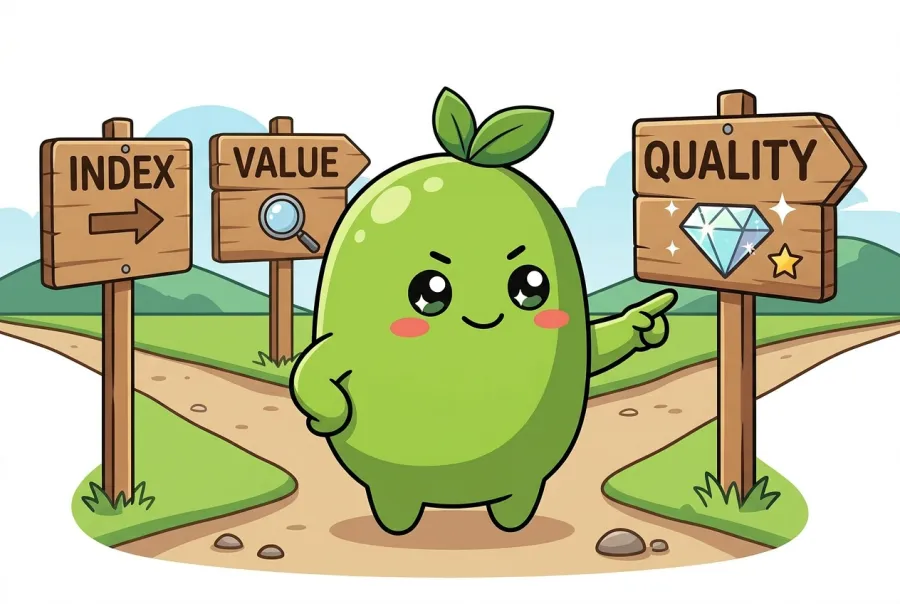
The Three Main Investing Approaches
You now understand that stocks are real businesses, that business quality varies enormously, and that long-term returns follow earnings. The next question is: how do you actually invest?
There are three broad approaches. Each has merit. Each has tradeoffs. Understanding all three will help you choose the one that fits your goals, time, and temperament.
Index Investing: Buy Everything, Think Nothing
The simplest strategy: buy a low-cost index fund that tracks the entire stock market. You own a tiny piece of every public company. You don't analyze anything. You don't pick winners. You just ride the market's long-term upward drift.
The intellectual case is strong. Most professional fund managers fail to beat the index after fees. Academic research consistently shows that the average investor is better off in a cheap index fund than picking stocks.
The good:
- Zero effort. Buy one fund and forget it.
- Maximum diversification. You own everything.
- Very low fees (0.03% to 0.10% per year).
- Historically returns ~10% per year over long periods.
The limitations:
- You own every business, including the terrible ones. An index fund holds companies losing money alongside the best companies in the world.
- No edge. Your return is the market return, by definition.
- During bear markets, you feel every percentage point of the decline.
Index investing is the right default. If you have no interest in learning about individual stocks, stop here. Buy a total market index fund, contribute regularly, and let compounding do its work over decades. You will do better than most professionals.
Value Investing: Buy What's Cheap
Value investing was pioneered by Benjamin Graham and popularized by Warren Buffett. The core idea: buy stocks that trade below their intrinsic value, then wait for the market to recognize the gap.
Value investors look for companies trading at low multiples: low P/E, low price-to-book, low price-to-free-cash-flow. They're bargain hunters. They want to buy a dollar of assets for 50 cents.
The good:
- Built-in safety margin. If you buy cheap enough, even bad outcomes can be tolerable.
- Decades of academic evidence that value stocks outperform over long periods.
- Forces discipline: you only buy when the price is right.
The limitations:
- Value traps. Some stocks are cheap for a reason. The business is declining, the industry is dying, or management is destroying value.
- You might miss the best companies in the world because they never look "cheap" by traditional metrics.
- Requires patience. Value investments can take years to pay off, and you may underperform the market for extended stretches.
Classic value investing works, but it has a blind spot: it focuses on what you pay and sometimes ignores what you're buying. A stock at 8x earnings is not a bargain if earnings are about to collapse.
Quality Investing: Buy What's Great
Quality investing flips the script. Instead of asking "is this cheap?" it asks: "is this an exceptional business?"
The insight is simple but powerful: great businesses compound value year after year. If you own a company that grows earnings at 15% annually for 20 years, the stock price will follow regardless of what you paid on day one.
"It's far better to buy a wonderful company at a fair price than a fair company at a wonderful price."
Warren Buffett
Quality investors look for:
- High and consistent returns on capital. The business generates far more profit than the capital invested.
- Durable competitive advantages. Something protects the business from competitors: a brand, network effects, switching costs, patents.
- Long runway for reinvestment. The company can keep growing for years or decades by reinvesting at high rates.
- Excellent management. Leaders who allocate capital wisely and act in shareholders' interests.
The good:
- The math of compounding works spectacularly with high-quality businesses. Time is your friend.
- You rarely need to sell. Great businesses keep getting better.
- Less stressful. Owning great businesses means drawdowns are temporary, not permanent.
The limitations:
- Great businesses are rarely cheap. You'll often pay full price, and sometimes overpay.
- Requires deep understanding of business models, competitive dynamics, and management quality.
- Not every "quality" stock delivers. Sometimes the market already prices in all the quality.
Where This Course Sits: Quality at a Reasonable Price
This course teaches a blend of quality and value investing, sometimes called QARP (Quality at a Reasonable Price). The framework combines the best of both approaches:
- From quality investing: focus on exceptional businesses with high returns on capital, strong moats, and long growth runways.
- From value investing: don't overpay. Even the best business in the world can be a bad investment at the wrong price.
The sweet spot? Finding great businesses that the market undervalues. Usually because of a temporary problem, a misunderstood business model, or a margin expansion story that hasn't played out yet. This is where the biggest returns live.
How to Choose Your Approach
Be honest with yourself about three things:
- Time. How many hours per week can you dedicate to investing? If the answer is zero, index. If it's 5+, individual stocks become viable.
- Temperament. Can you watch a stock drop 30% and not panic? If market volatility ruins your sleep, index investing removes that stress.
- Interest. Do you genuinely enjoy learning about businesses? Quality investing requires curiosity about how companies work. If reading annual reports sounds like torture, it's not for you.
There's no wrong answer. Many successful investors combine strategies: a core index position for stability, with individual quality stocks for potential outperformance.
The rest of this course dives deep into quality investing: how to identify great businesses, evaluate their competitive positions, assess management, and decide when to buy. If you've read this far, you probably have the curiosity to go further.
Ready to learn what makes a great company? The next part breaks down the characteristics that separate compounders from pretenders. Preview quality stocks on Beanvest to see these metrics in action.

- Index investing is the right default. Most people should start and possibly stop here.
- Value investing buys cheap assets. Quality investing buys exceptional businesses.
- The best approach combines both: quality businesses at reasonable prices (QARP).
- Choose your strategy based on time, temperament, and genuine interest in business analysis.