The Money-Printing Machine
What Is a Business, Really?
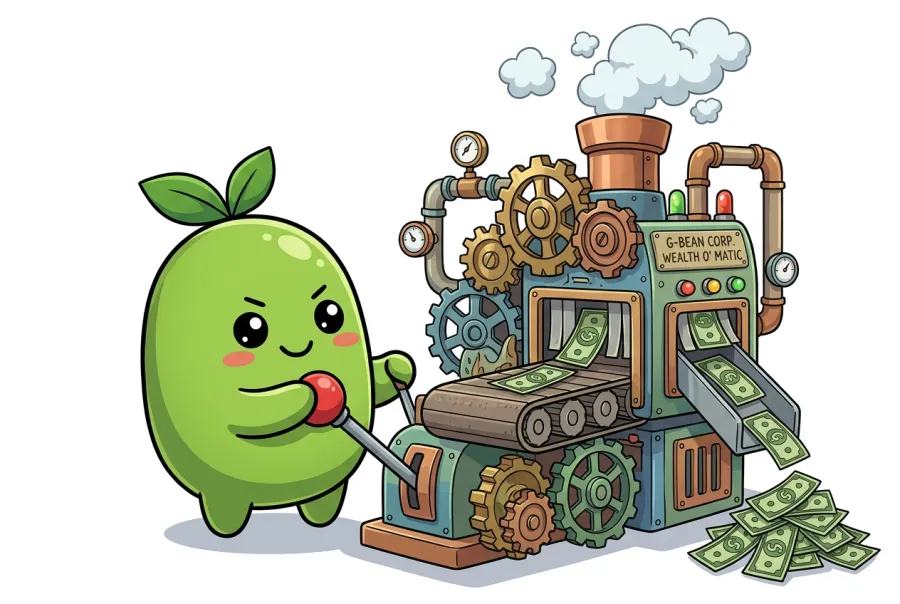
Strip away the logos, the offices, the mission statements. At its core, every business is a machine that converts inputs into money.
A restaurant takes ingredients, labor, and rent, then produces meals that customers pay for. A software company takes engineers and servers, then produces code that customers subscribe to. A bank takes deposits and lends them out at higher rates.
The inputs cost money. The outputs generate money. The difference between the two is profit. That's it. Every business on earth works this way.
When you buy a stock, you're buying a piece of that machine. The question isn't "will the stock go up?" The question is: how good is this machine at turning inputs into profits?
How a Business Makes Money: Revenue, Costs, and Profit
Let's use a simple example. Imagine you open a coffee shop.
You sell 1,000 cups of coffee per month at $5 each. That's $5,000 in revenue. Revenue is the total amount customers pay you. It's the top line of the financial statement, because it appears at the very top.
But revenue isn't profit. You have costs:
- Cost of goods sold (COGS): coffee beans, milk, cups. Maybe $1,500/month.
- Operating expenses: rent, staff wages, electricity. Maybe $2,500/month.
Revenue ($5,000) minus all costs ($4,000) leaves you with $1,000 in profit. That's what the business actually earned. That's what belongs to the owner.
In the stock market, this number is called net income or earnings. When divided by the number of shares outstanding, it becomes Earnings Per Share (EPS), the number we introduced in the previous lesson.
The Income Statement: A Business in Three Lines
Every public company publishes an income statement every quarter. It looks complicated, but the structure is simple:
| Line | What it means | Coffee Shop |
|---|---|---|
| Revenue | What customers pay | $5,000 |
| Gross Profit | Revenue minus cost of goods | $3,500 |
| Operating Profit | Gross profit minus operating expenses | $1,000 |
| Net Income | What's left after taxes and interest | $800 |
Each line removes another layer of costs. Revenue is the biggest number. Net income is what actually flows to the owners. As an investor, you care most about the bottom line, but understanding each layer tells you where the money goes.
What Is Free Cash Flow and Why Does It Matter?
Net income has a problem: it includes non-cash items. Accountants use rules like depreciation and amortization that reduce reported earnings without any actual cash leaving the business.
That's why experienced investors focus on free cash flow (FCF): the actual cash a business generates after paying for everything it needs to keep running and growing.
"The value of a business is the cash it generates over its lifetime, discounted back to today."
Think of it this way: net income is what accountants say you earned. Free cash flow is what you can actually put in your pocket. For many companies, these numbers are similar. But when they diverge, free cash flow tells the truer story.
A company with growing earnings but shrinking free cash flow is a red flag. A company with modest earnings but strong free cash flow is often a hidden gem.
What Does a Company Do With Its Profits?
Once a business earns money, it has five options:
- Reinvest in the business. Build new stores, develop new products, hire more engineers. This is how companies grow. If a company can reinvest at high rates of return, this is the best use of profits.
- Pay dividends. Distribute cash directly to shareholders. You get a check every quarter. Mature companies with limited reinvestment opportunities often do this.
- Buy back shares. The company buys its own stock on the open market, reducing the number of shares outstanding. Each remaining share now represents a bigger piece of the business.
- Acquire other companies. Use the cash to buy another business. This can be brilliant or disastrous depending on the price paid and the strategic fit.
- Pay down debt. Reduce borrowings to lower interest costs and strengthen the balance sheet. This is especially smart when interest rates are high or when a company is heavily leveraged.
The best companies earn high returns on the money they reinvest. They don't need to pay dividends because every dollar kept inside the business generates more value than a dollar returned to shareholders. We'll explore this concept deeply in the lesson on ROIC.
Why Revenue Growth Alone Is Misleading
Many beginners focus on revenue growth. "This company is growing revenue 40% per year!" Sounds impressive. But revenue without profit is just activity, not progress.
Consider two companies:
| Company A | Company B | |
|---|---|---|
| Revenue | $1 billion | $200 million |
| Revenue Growth | +40% | +15% |
| Net Income | -$100 million | $50 million |
| Free Cash Flow | -$200 million | $60 million |
Company A is growing faster, but it's burning cash. Every new customer costs more to acquire than they generate. Company B is smaller but profitable. It generates real cash that can be reinvested or returned to shareholders.
Which machine would you rather own? The one that gets bigger every year but never produces profit? Or the smaller one that prints real money?
Growth matters, but only when it leads to profits. The best businesses grow revenue and profits simultaneously. That's the money-printing machine you want to own.
How to Read a Company's Financials on Beanvest
You don't need to dig through SEC filings to understand a company's financials. On Beanvest, every stock page shows the key numbers: revenue, net income, free cash flow, and margins, all visualized over time.
Look for companies where revenue, earnings, and free cash flow all grow together. That's the sign of a healthy money-printing machine. Browse quality stocks to see these metrics in action.

- A business is a machine that converts inputs into profits. The stock price follows the quality of that machine.
- Revenue is what customers pay. Net income is what the business keeps. Free cash flow is what you can actually pocket.
- Companies can reinvest, pay dividends, buy back shares, acquire, or pay down debt. The best companies reinvest at high returns.
- Revenue growth without profit is just activity. Look for companies that grow revenue and earnings together.